 |
 |
| LEFT: JÖRG P. ANDERS / KUPFERSTICHKABINETT, STAATLICHE MUSEEN / BPK / ART Resources Right: MELCHIOR LORCK / Individual Drove / BRIDGEMAN IMAGES; |
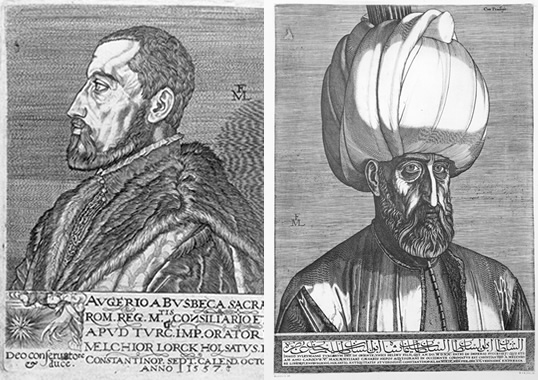
| Left: Ogier Ghiselan de Busbecq was 32 when he met 60-twelvemonth-old Suleiman the Magnificent, correct, and the 2 held their first frosty peace talks in Amasya, Turkey, in 1555. Busbecq'due south long trip from Vienna allowed him to engage in his favorite pastimes: visiting classical ruins, collecting ancient coins and manuscripts and documenting all that he saw. Suleiman substantially increased the size of the Ottoman Empire during his 46-year reign, pushing to the gates of Vienna, the Hapsburg capital, in 1529. The Hapburgs and the Ottomans jockeyed for territory in the Balkans after that, both on the battlefield and through diplomacy. |
When Ogier Ghiselan de Busbecq was born in the Flemish town of Comines well-nigh the village of Busbecq in 1522, few would have predicted the role he would play as an intermediary between his fellow Europeans and their imperial neighbors, the Ottoman Turks. Equally the illegitimate son of the Count of Busbecq, a nobleman in the courtroom of Ferdinand i, the Hapsburg archduke of Austria, his birth was not especially propitious.

 |
| JOSEF Kiss AND FRIEDRICH MAYRHOFER / DE AGOSTINI Pic LIBRARY / A. DAGLI ORTI / BRIDGEMAN IMAGES (Item) |
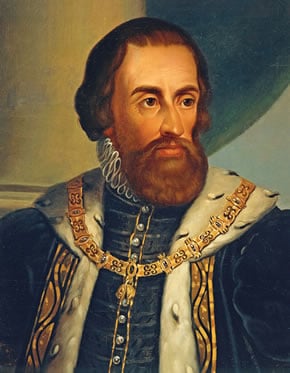
| Ferdinand i, Hapsburg archduke of Austria, dispatched Busbecq to make a peace agreement with Suleiman the Magnificent. The Hapsburgs and the Ottomans were contesting Transylvania, and then on the border betwixt East and West. |
 n time, however, he would earn a proper noun for himself not only as a diplomat to the court of the Ottoman Sultan Suleiman the Magnificent, just likewise as a respected writer. For an audience eager to know its geopolitical rival, military foe and occasional ally, his published correspondence provided a uniquely aboveboard and popular "insider's view" of the workings of the virtually powerful empire of the mean solar day.
At the fourth dimension of Busbecq's birth, western Europeans were looking warily to the East. It was within living memory that in 1453 the Ottomans nether Mehmed ii captured the Byzantine capital of Constantinople (today's Istanbul). I year before the boy's nativity, in 1521, Mehmed's great-grandson Suleiman conquered Belgrade, which put the Hungarian capital of Buda (now Budapest) within his sights. Eight years later that, Ottoman forces were besieging the gates of Vienna.
The Turkish advance was halted, but their power was feared and the Hapsburg-Ottoman continental rivalry endured, both on the battleground and through diplomacy. As in many campaigns, propaganda was a weapon. In western chronicles of the era, "the inhumanity of the Turks was emphasized above all else, and the stereotyped Turk, villainous, savage and bloodthirsty … was firmly established in the historical traditions of the West," wrote Sıla enlen of Ankara University in a 2005 paper. For their office, the Turks looked upon the Latin Christians with disdain.
It was Busbecq who offered a more balanced view of the Ottomans to his fellow Europeans, based on firsthand feel. As Archduke Ferdinand'south envoy to Turkey from 1554 to 1562, he wrote a series of messages to his friend Nicholas Michault, who was at that fourth dimension a boyfriend Hapsburg diplomat assigned to the Portuguese courtroom. A keen observer of both nature and human nature, Busbecq marveled at the beauty of the Ottoman lands. He delighted in the Turks' kindness toward animals, and he greatly admired the discipline and fortitude of the common Turkish soldier. He was besides sincerely impressed past the grandeur of the Ottoman court and of a bureaucracy he institute staffed by men who were valued for their talent rather than their family ties.
 |
| ALI AMIR BEG / TOPKAPI PALACE MUSEUM / ARCHIVES CHARMET / BRIDGEMAN IMAGES |
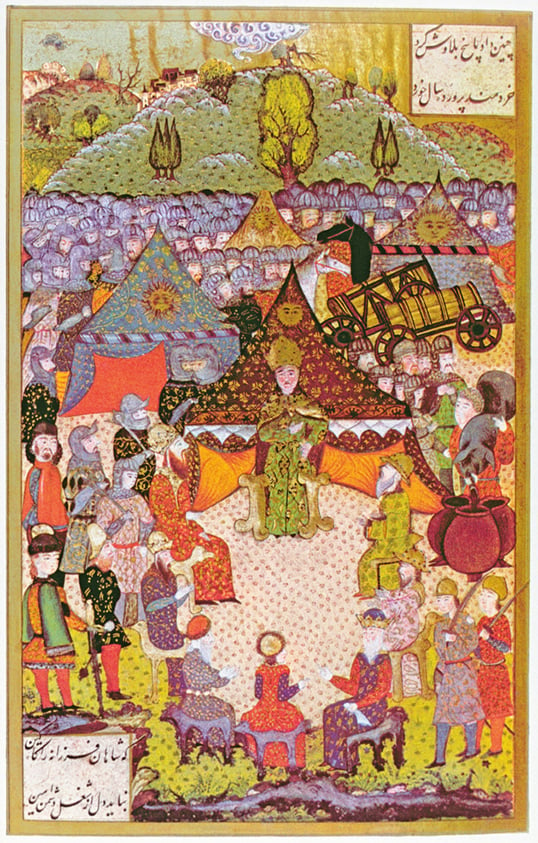
| Louis ii, king of Republic of hungary, is shown holding counsel with his nobles prior to the Battle of Mohacs in 1526. He lost the battle—and his life—to the forces of Suleiman. |
Yet for all his admiration for the Ottoman systems of society and government, Busbecq was clear-eyed about the threat Suleiman posed to a less-than-united western Europe. "On their side are the resources of a mighty empire, strength unimpaired, experience and practice in fighting, a veteran soldiery, habituation to victory, endurance of toil, unity, club, subject area, frugality and watchfulness," he wrote. "On our side is public poverty, individual luxury, impaired strength, broken spirit, lack of endurance and training…. If at that place is state of war can we doubtfulness what the consequence will be?"
Busbecq was relatively new to the role of diplomat when he set out as the Hapsburg ambassador to Turkey in the autumn of 1554. His only previous assignment had been earlier that twelvemonth to England, where he served every bit Ferdinand'due south representative at the wedding ceremony of Ferdinand's nephew, Philip ii of Kingdom of spain, to Mary Tudor. His new posting promised to be far less sanguine: Ferdinand had invaded the Ottoman protectorate of Transylvania in 1551, breaking a iv-twelvemonth truce that had stanched well-nigh three decades of intermittent war between Republic of hungary and Turkey. Suleiman was angry.
Indeed, upon hearing the news of Ferdinand's incursion, Suleiman had thrown the previous Hapsburg ambassador into jail, where he remained for ii years earlier being allowed to render home, simply to die soon later on. It was now upward to Busbecq to repair securely frayed relations and conclude a new treaty acceptable to both Suleiman and Ferdinand. The task would evidence ho-hum and exceedingly boring. Merely Busbecq was a patient man, and during the seven years he spent in Turkey (they were not consecutive years: He served from 1554-1555 and again from 1556-1562), he grew to understand and appreciate the qualities that had brought the Ottomans to the noon of their power.
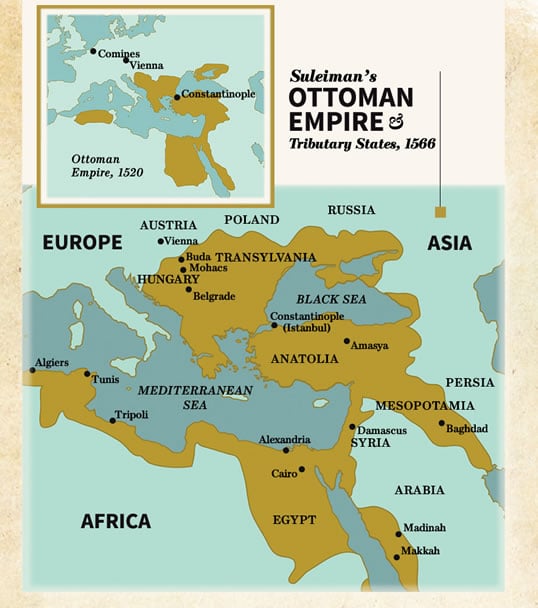
When Suleiman came to the throne in 1520, his empire included Anatolia, most of Arab republic of egypt, Syria and the Balkan states. By the fourth dimension of his expiry in 1566, he had extended Ottoman control from Budapest on the Danube to Aswan on the Nile, and from the Euphrates River through North Africa nearly to Gibraltar.
 |
| BIBLIOTHÈQUE NATIONALE / BRIDGEMAN IMAGES |
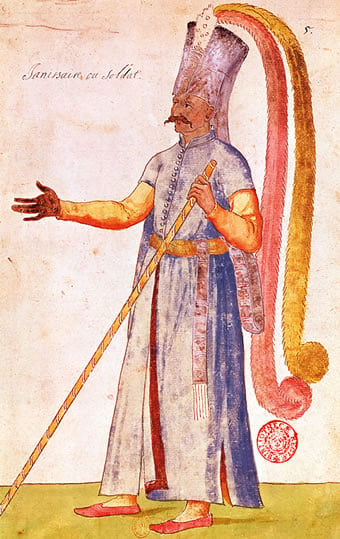
| Colorfully garbed Janissaries, the special forces of the Ottomans, impressed Busbecq with their fine appearance when he viewed them on his arrival in Amasya in May 1555. |
Suleiman besides took sides in struggles inside Europe: In 1536, he allied with France against the Holy Roman Emperor, Charles v, and Suleiman received assist from the French king in his ongoing confrontation with the Hapsburg confederation. More direct assist came from the legendary admiral of his armada, Hayreddin Barbarossa, who won the critical victories at sea that secured Suleiman's command of the Mediterranean.
Nevertheless, as successful as his armed services campaigns were, Suleiman'southward interests extended beyond conquest. Known as Suleiman Kanuni (Lawgiver) in his domains, he reorganized Ottoman canon law and profoundly expanded the rights of the empire's not-Muslim populations, including Christians and Jews. Nor did he fail the arts: During his reign, Ottoman architecture reached its zenith and Ottoman silk, drinking glass and Iznik ceramics were coveted throughout Europe for their beautiful patterns and fine workmanship.
Ottoman didactics, though largely limited to those who would later administrate the empire, was also of a loftier standard. The curriculum included verse, literature, history, law and religion, and students were taught to read and write in Turkish, Arabic and Western farsi.
By contrast, western Europe was a conglomeration of frequently-hostile states whose anchor, the Catholic faith, had been shaken by the Reformation. Nevertheless Europe, as well, had its glories, not least the unrivaled arts of the Renaissance. The Venetian painters Bellini and Titian were well known to the Ottoman sultans, every bit were the Renaissance monarchs: Henry viii of England and his daughter Elizabeth i; Francis i of France; Charles v and his son Philip ii; and—peculiarly well known to Suleiman—Charles's younger brother, Ferdinand i, himself Holy Roman Emperor from 1558 to 1564.
Equally in Turkey, educational activity in Europe was reserved for the few. Busbecq was awarded a degree in advanced Latin studies at the University of Louvain in Kingdom of belgium and connected scholarly pursuits in Paris, Venice, Bologna and Padua, keeping remarkably complete notes of all he saw and learned. These notes provided the foundation for the letters he wrote to Michault.
Busbecq and Michault had attended school together and, as diplomats, they understood the difficulties inherent in maintaining a pleasant and persuasive presence no matter how hard the negotiations at hand. Still, Busbecq'south letters extended well across the confines of his workday.
His outset letter dates to September 1, 1555, shortly after he had returned to Vienna from his initial audience with the sultan, which took place in Amasya, in n-primal Turkey, a city so far from the Hapsburg capital—some i,850 kilometers—that he may have been the starting time European to visit that area since the Seljuk Turks conquered it tardily in the 9th century.
 |
| TOPKAPI PALACE MUSEUM / DOST YAYINLARI / BRIDGEMAN IMAGES |
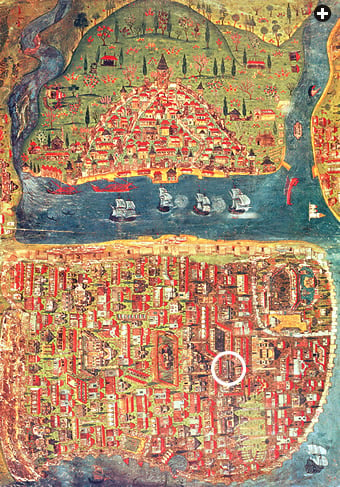
| This map of 16th-century Constantinople shows the western side of the Ottoman capital, with the Golden Horn running through the eye and upwards the left-manus side. A small-scale portion of the urban center'southward Asian side is shown at right. Busbecq lived in Elçï Han, nigh the Atik Ali mosque, as circled, in a higher place. |
The trip began well. Barely had Busbecq crossed into Turkish territories near Gran (today'south Esztergom) in Hungary than he found himself in the midst of an escort of 150 splendidly arrayed cavalrymen and their officers, whom he found surprisingly gracious.
Busbecq journeyed with this handsome escort to the upper-case letter at Buda, a urban center once renowned for its decorative palaces and glittering lifestyle, but more than recently known as the home of Hungary'due south naïve young King Louis ii, who ruled from 1516 to 1526. Perhaps overvaluing his country's defenses, Louis had neglected to renew a long-continuing peace treaty with the Turks. It was a catastrophic oversight: In 1526, Suleiman all only annihilated the Hungarian army at the Battle of Mohacs, where Louis, only 20 and childless, lost his life.
By treaty, his blood brother-in-law, Ferdinand of Hapsburg, should have ascended the throne. But Hungarian electors, wishing to remain contained of Hapsburg influence, selected instead John Zápolya of Transylvania to wear the crown. In 1529, Zápolya allied with Suleiman to protect himself and his realm from Ferdinand. In that, Suleiman shared an interest: The terminal thing he wanted was to have his archrivals, the Hapsburgs, as side by side-door neighbors.
All remained quiet for a decade or so, until 1540, when Zápolya died. Ferdinand so attacked and chop-chop captured Buda. Zápolya's widow, the queen dowager for her infant son, turned to Suleiman, who marched on the urban center in 1541 and hands took it, making eastern Hungary an Ottoman protectorate.
This was a state of diplomacy Ferdinand could not abide. Incursion after incursion followed until a serial of defeats at Ottoman easily forced Ferdinand and his powerful brother, Charles v, to sign a peace treaty with Suleiman. That was in 1547. Only the prize of a united Hungary was too neat a dream for Ferdinand to relinquish and so hands: In 1551 he marched into Transylvania again, and it was the repercussions of this that Busbecq was sent to sort out.
That item task lay in the hereafter, however. In 1554, as Busbecq undertook his consignment, he meant to enjoy his journey, taking intendance to note all he saw and learned. He was particularly taken by the flowers, which he found in profusion in Adrianople (today's Edirne, on Turkey's border with Greece and Bulgaria). But fifty-fifty Adrianople was overshadowed by Constantinople, which delighted Busbecq with its wealth of ancient monuments and marvelous views of the surrounding seas and magnificent countryside.
 |
| TOPKAPI PALACE / PICTURES FROM HISTORY / BRIDGEMAN IMAGES |
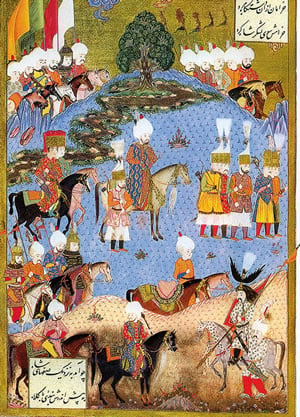
| Sultan Suleiman personally led his armies to Transylvania, the Caspian and much of the Middle East. This portrait of him with his troops was made in 1561. |
Had Suleiman been in residence, Busbecq's journey would have concluded here. But the Sultan was negotiating a peace treaty with the Safavid ruler of Persia in Amasya, some 565 kilometers away, and he asked the diplomat to join him there. For Busbecq, the 13-mean solar day journey was filled with pleasures. Hither was the chance to view the classical ruins he dearly loved, and to collect ancient coins, manuscripts and inscriptions.
It too gave him the hazard to run into the local sheep whose "very fatty and weighty tails," he wrote, could "grow so big in some old sheep, that they are forced to lay them upon a plank, running on ii fiddling wheels, so they may draw them subsequently them, non existence otherwise able to trail them along."
Busbecq arrived in Amasya on April seven, 1555. Following the customary interview with the attendant pashas, he met the sultan, who was not pleased by what he heard. Suleiman "listened to the recital of my message," Busbecq wrote, "simply, as it did not represent with his expectations (for the demands of my master were full of dignity and independence, and, therefore, far from acceptable to i who idea that his slightest wishes ought to exist obeyed), he assumed an expression of disdain, and merely answered, 'Giusel, giusel,' that is, 'well, well.' We were then dismissed to our lodging."
In Amasya, Busbecq witnessed a large gathering of the Ottoman military for the kickoff time. Greatly impressed by the troops' discipline and colorful dress, he was more impressed all the same by their leaders who, he concluded, had the ability and preparation to perform their duties with such skill and efficiency that "the Turks succeed in all that they attempt and are a dominating race and daily extend the bounds of their rule."
On June 2, Busbecq and his delegation paid a bye visit to Suleiman. He presented them with a "dispatch wrapped upwards in material of aureate and sealed," only rather than the peace treaty Busbecq hoped for, he wrote, information technology offered only a six-month truce with the request that "a further respond [be] brought back."
Busbecq arrived in Vienna in August 1555, wearied by the journey. In November, he set out once again with Ferdinand's reply, arriving to a reception far less cordial than the previous year. Later learning that Ferdinand connected to assert his right to the Hungarian throne, the pashas refused to grant Busbecq an audience with the sultan, cautioning that "we should keep serenity and not arouse the sleeping lion nor hasten on the troubles which were certain to come upon us soon enough," he wrote.
In fact, as Busbecq reported in his letter of the alphabet of July xiv, 1556, barely had he and his staff reached their diplomatic mission than they were confined and treated "in every fashion most as prisoners instead of ambassadors. This has continued at present for 6 months, and we have no idea what the futurity has in shop for usa.''
Busbecq'south tertiary letter of the alphabet is dated June 1, 1560. He noted that his colleagues had been allowed to leave Constantinople at the end of August 1557 and that he might have joined them had he wished. Just he stayed on, believing that if he departed it might suggest that peace negotiations had come to an end, an impression to be avoided at all costs as information technology might make "a terrible state of war inevitable."
In response to a query from Michault, Busbecq reported that the but time he left the embassy was when he had dispatches from Ferdinand to present to the sultan. This occurred only two or three times a year, "So I stay at domicile and hold communion with those former friends, my books; they are my companions and the joy of my life," he wrote. He noted, however, that he had other companions in the grade of a large menagerie that included everything from well-bred horses to a diversity of weasels.
This quiet life before long inverse, however, every bit Busbecq told Michault in his quaternary alphabetic character, written after he had returned to Vienna in 1562.
The changes began with a distressing event. For more than 30 years Suleiman and Charles v had vied for control of the Mediterranean, a rivalry pursued past Charles'south son, Philip ii, when he succeeded his father to the Spanish throne in 1556. In 1559, Philip ended a program to accept the port of Tripoli (in present-day Libya) and sent a fleet of 50 galleys with some 6,000 soldiers to the proposed staging point, the island of Djerba, off the coast of Tunisia.
But things did non get well. Barely had the Spanish captured Djerba and erected a fort than they were taken unawares by the Turks, who destroyed their galleys and cut off their water supply. Only the commanders survived, to be sent as trophies to Suleiman. On October 1, 1660, the victorious Ottoman armada rounded Seraglio Bespeak below the sultan's palace and sailed into the Gilded Horn. It was a sight Busbecq would never forget.
The half-starved Spanish officers were displayed on the poop deck of the brightly colored Turkish flagship while their captured galleys were "towed along, stripped of their oars and bulwarks and reduced to mere hulks, so that in this condition they might seem small, shapeless and contemptible in comparison with the Turkish vessels," Busbecq wrote.
 |
| PRIVATE Collection / BRIDGEMAN IMAGES |
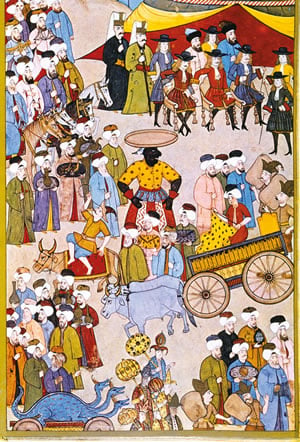
| European ambassadors sit, upper correct, with merchants, acrobats and cavalry, in this 16th-century scene dating to the reign of Suleiman's grandson Murad iii. |
Busbecq felt information technology his duty to assist the prisoners as all-time he could. In addition to supplying them with boiled mutton, he fulfilled their requests for blankets, shoes, cloaks and even wine. A more expensive asking came from those "who wished me to human action every bit surety for their ransom," he noted. Busbecq loaned money to them all, confiding to Michault that even if he were non repaid, "I must not listen; a good action performed for a good man is never wholly lost. Most of them will certainly keep their word."
Busbecq'south kickoff objective, however, was to negotiate the long-sought peace treaty with Suleiman's k vizier, Rustem Pasha, whom he described as a man who "wished his words to be looked upon every bit orders" and who "never deviated from his customary rudeness." Busbecq became peculiarly annoyed with Rustem Pasha when plague struck Constantinople and the vizier would not allow Busbecq and his household staff to retire to a safer identify.
Then, quite unexpectedly, Rustem Pasha died of dropsy. He was replaced past Ali Pasha, whom Busbecq found to be "a delightfully intelligent person, and by no ways lacking in humanity."
Ali Pasha immediately allowed Busbecq to retire to a suitable identify until the plague abated. The diplomat chose the fiddling island of Prinkipo, where he delighted in angling, hiking and simply breathing the fresh air.
As Ali Pasha had likewise retired to the island, the two became friends and, once they returned to Constantinople, shortly negotiated a truce, under which the current borders would stand and Ferdinand would pay a small tribute. Peace—for a time at least—had been secured.
By Baronial 1562, Busbecq was ready to return to Vienna. As a parting gift, Ali Pasha gave him 3 thoroughbred horses of far higher quality than those he could have obtained on his ain. In render, Busbecq gave Ali Pasha a coat of post ample plenty "to fit his alpine and stout frame" and a charger sturdy plenty "to deport his not bad weight."
Following his return to Vienna, Busbecq continued to serve as a diplomat for Ferdinand, and later for Ferdinand's son Maximillian two and grandson Rudolf ii. In 1592, at the age of 71, he set out from an assignment in Paris to visit his beloved home in Busbecq. His route took him through Normandy where soldiers engaged in the region'southward civil state of war ignored Busbecq'south diplomatic status and seized him. The fracas was too much for the aging Busbecq, and he died 11 days later, on Oct 28. Busbecq was buried in the church building in St. Germain, Normandy, only his heart was enclosed in a leaden catafalque and placed in the family tomb at Busbecq.
Busbecq left an impressive legacy. His pursuit of antiquities generated a wealth of knowledge for western Europe about classical Greece and Rome. He nerveless 240 classical manuscripts, which he donated to the Vienna Imperial Library (now the Austrian National Library), together with a valuable money collection. He also discovered in Constantinople a spectacular 500-year-old copy of De Materia Medica, the remarkable compendium of medicinal herbs by the first-century ce Greek dr. Dioscorides that was the cornerstone of herbal therapeutic knowledge for centuries. Caused by Maximillian 2 on Busbecq's recommendation, information technology remains ane of the finest known examples of a belatedly-antique scientific text.
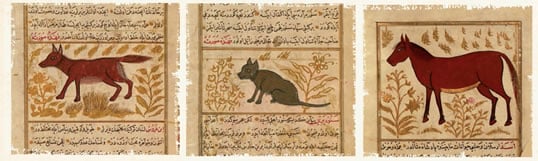 |
| WALTERS Fine art MUSEUM (3) |
| Busbecq was fond of animals, and he kept and wrote about many, from wolves to horses to ducks. These later Turkish miniatures show a jackal, a cat and a horse. |
Busbecq is also credited with introducing the llac to the Westward, and some say the tulip equally well. He even brought dorsum part of his menagerie, including half dozen she-camels, his beautiful horses and a large tame mongoose called an ichneumon. Yet, every bit precious every bit these gifts were, the proper noun Busbecq is almost closely associated with his boggling letters.
The offset letter was published in the original Latin every bit Itinera Constantinopolitanum et Amasianum (Travels to Constantinople and Amasya) in 1581, and all four letters appeared in 1589. They went through several printings and were translated into French, German, Dutch, Castilian and English language every bit The Turkish Letters of Ogier Ghiselin de Busbecq, which remains in print today.
For many years, they were among the almost popular books in Europe. Fifty-fifty now, those who wish to know about the 16th-century Ottoman world turn to Busbecq to see, as he did, the impressive parades, the colorful costumes, the gaily caparisoned horses and the ubiquitous camels who "kneel in a circle with their heads close together, eating and drinking with the utmost skillful will out of the same manger or basin, content with the scantiest fare."
In his fourth dimension, no one described Ottoman Turkey better.
 | Jane Waldron Grutz ([email protected]) is a former staff author for Saudi Aramco who now divides her time betwixt Houston and London. She is a regular contributor to AramcoWorld. |
0 Response to "From Reading Busbecq Letters What Conclusions Can You Draw About the Ottoman Empire Under Suleiman"
Post a Comment